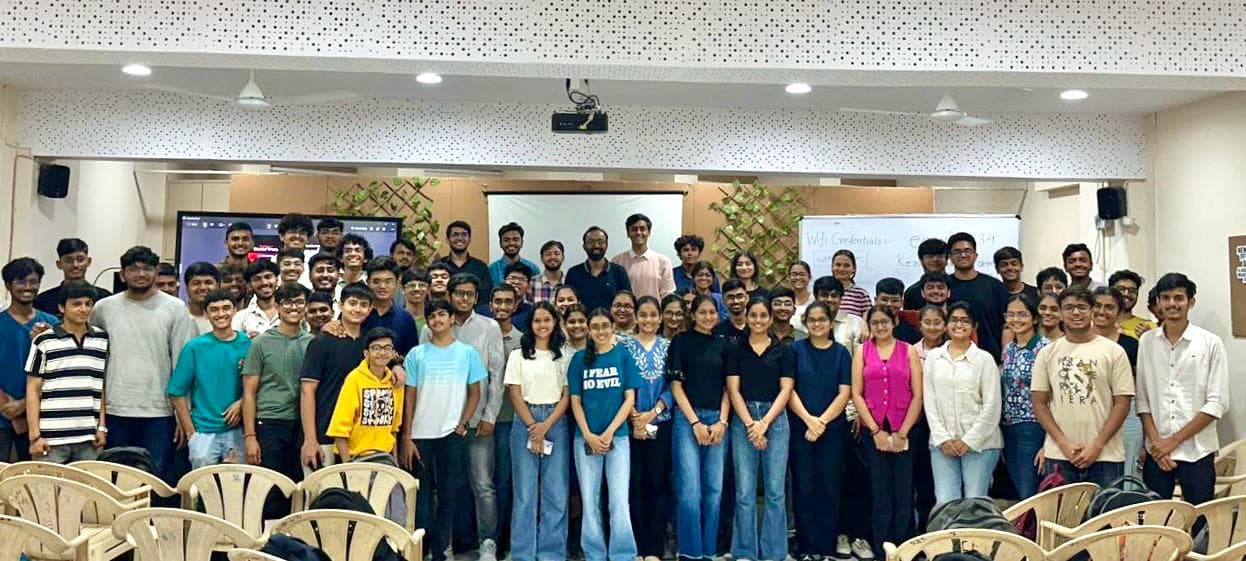
Venue
Chemical Engg. Seminar Hall, SCET
Organized By
SYNERGY.io Club
Coordinators
About the Workshop
The SYNERGY.io Club, a student-driven initiative under the Mechanical Engineering Department at SCET, organized a hands-on workshop titled “ESP32 – Masterclass.” This two-hour session provided students with practical knowledge and experience using the ESP32 microcontroller—a high-performance board widely used in IoT (Internet of Things) and embedded systems. The workshop was conducted through the online simulator WOKWI, enabling participants to code and test their programs without the need for physical hardware.
Objective
The primary goal of the workshop was to introduce students to the world of embedded systems and IoT development. It aimed to strengthen their technical foundation while promoting hands-on learning in sensor integration, digital control, and real-time system response. The enthusiastic participation of over 85 students reflected the growing interest in IoT and the need for skill-based learning beyond theoretical knowledge.
Session Highlights
The masterclass followed a structured, progressive learning format that guided students through the essential concepts and real-time coding tasks involving the ESP32 board.
- ESP32 Overview: Covered dual-core processing (up to 240 MHz), in-built Wi-Fi and Bluetooth capabilities, and over 30 GPIO pins.
- Practical Demonstrations: Showcased real-world applications like an MQTT client, Robocar, and a 4-legged bionic robospider (ACEBOT).
- Hands-On Coding Modules:Basic Programming: The classic “Hello World” LED blink program.
- Pushbutton Integration: Using digitalRead() to control LEDs through input signals.
- Sensor Module: Reading live temperature and humidity data using the DHT22 sensor.
- Buzzer Control: Generating sound alerts using tone() and noTone().
The Challenge Segment
To conclude the workshop, participants took part in a challenge titled “Your Objective Challenge.” The task was to design a smart temperature-reactive alarm system that could automatically respond to varying temperature levels based on sensor input.
The challenge involved two main parts:
- Temperature Alerts:Normal (<28°C): LED and Buzzer OFF
- Warning (28°C–32°C): LED blinks slowly, Buzzer OFF
- Danger (>32°C): LED solid ON, Buzzer continuous ON
- Pushbutton Functionality: Modified to print “System Status: OK” on the Serial Monitor when pressed.
Learning Outcome
By completing the modules and final challenge, participants gained practical insights into coding logic, sensor integration, and real-time data handling. The simulated approach through WOKWI ensured that every student could learn, code, and test successfully, regardless of hardware availability.
Closing Note
SYNERGY.io Club extends heartfelt gratitude to Dr. Samip Shah (Faculty Coordinator), Dr. Pankaj Gohil (Head of Department), and Dr. Hiren Patel (Principal) for their continued motivation and support in making this event possible.
With the success of this workshop, SYNERGY.io Club – SCET reaffirms its mission to organize more innovative, technically enriching events that empower students to explore, experiment, and excel in the field of technology.